
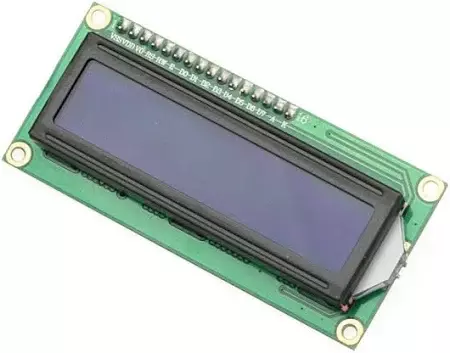
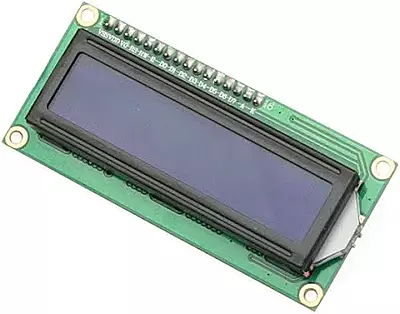


16x2 LCD Display Module with I2C Interface for Arduino, ESP32 & Raspberry Pi (1602 LCD)
Display text and project data with ease using the 16x2 LCD Display Module with I2C Interface. This compact 1602 character LCD features an integrated I2C backpack, reducing the number of GPIO pins required and simplifying connections with Arduino, ESP32, Raspberry Pi, NodeMCU, STM32, and other microcontrollers. Ideal for DIY electronics, IoT, robotics, automation, embedded systems, and educational projects, this module provides a clear 16-character × 2-line display with adjustable contrast and low power consumption for reliable performance.
Customize
Share :
Capable of displaying 16 characters across 2 lines, this LCD is ideal for showing sensor readings, menus, messages, system status, temperature, humidity, voltage, GPS coordinates, and other real-time information. The built-in backlight ensures excellent readability in various lighting conditions, while the adjustable contrast allows users to fine-tune the display for optimal visibility.
Compatible with Arduino Uno, Mega, Nano, ESP32, ESP8266 NodeMCU, Raspberry Pi, STM32, and many other development boards, the 16x2 I2C LCD is an essential component for makers, students, engineers, and professionals.
Key Features
- 16 Characters × 2 Lines LCD Display
- Integrated I2C Interface for Easy Wiring
- Only 4-Pin Connection Required (VCC, GND, SDA, SCL)
- HD44780-Compatible Controller
- Blue Backlight with White Characters (Verify according to manufacturer specification)
- Adjustable Contrast via Onboard Potentiometer
- Low Power Consumption
- Fast Data Display
- Easy Arduino Library Support
- Compact PCB Design
- Suitable for Embedded Systems
- Compatible with 3.3V & 5V Logic (Verify according to manufacturer specification)
- Ideal for DIY Electronics and STEM Projects
Technical Specifications
| Specification | Details |
|---|---|
| Product Type | 16x2 LCD Display Module with I2C |
| Display Size | 16 Characters × 2 Lines |
| LCD Type | Character LCD |
| Interface | I2C |
| Controller | HD44780 Compatible |
| Display Color | Blue Backlight with White Characters |
| Operating Voltage | 5V DC |
| Communication | I2C (SDA, SCL) |
| Contrast Adjustment | Onboard Potentiometer |
| Backlight | LED Backlight |
| Viewing Format | 16 × 2 Characters |
| Compatible Boards | Arduino, ESP32, Raspberry Pi, NodeMCU, STM32 |
| Mounting | PCB Module |
Applications
- Arduino Projects
- ESP32 Projects
- Raspberry Pi Displays
- IoT Dashboards
- Robotics
- Home Automation
- Weather Stations
- Temperature Monitoring
- Humidity Monitoring
- GPS Display Systems
- Industrial Automation
- Data Logging
- Smart Agriculture
- Educational Electronics
- DIY Embedded Systems
Package Includes
- 1 × 16x2 LCD Display Module with I2C Interface
Why Buy from Horizocart?
- Genuine quality-tested display modules
- Ideal for beginners and professionals
- Fast shipping across India
- Secure packaging
- Competitive pricing
- Trusted electronics and IoT supplier
- Excellent customer support
- Suitable for education, prototyping, and industrial applications
Frequently Asked Questions
Q. Is this LCD compatible with Arduino Uno?
Yes. It is fully compatible with Arduino Uno, Nano, Mega, Leonardo, and other Arduino-compatible boards.
Q. Does it work with ESP32?
Yes. The module supports ESP32 through the I2C interface.
Q. Can I use it with Raspberry Pi?
Yes. It can be connected to Raspberry Pi using the I2C interface and appropriate software libraries.
Q. How many GPIO pins are required?
Only 4 pins are required: VCC, GND, SDA, and SCL.
Q. Is the display backlit?
Yes. It includes an LED backlight for improved visibility.
Q. Can I adjust the display contrast?
Yes. An onboard potentiometer allows easy contrast adjustment.
Q. Which Arduino library is commonly used?
The LiquidCrystal_I2C library is widely used for interfacing this display with Arduino-compatible boards.