


PIR Motion Sensor Module (HC-SR501) for Arduino, ESP32 & Raspberry Pi | Passive Infrared Motion Detector
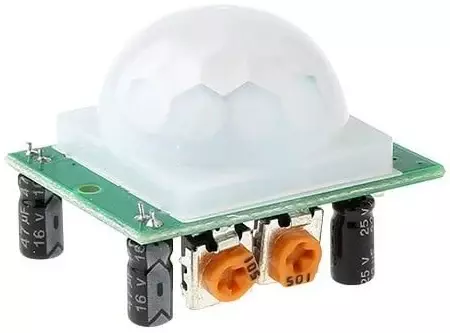
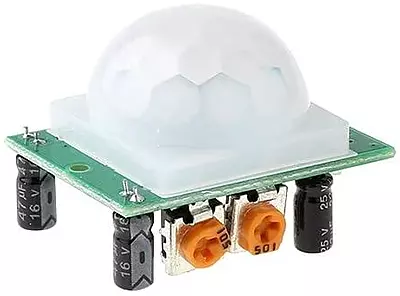
Detect human movement efficiently with the PIR Motion Sensor Module (HC-SR501), compatible with Arduino, ESP32, Raspberry Pi, NodeMCU, STM32, and other development boards. Using Passive Infrared (PIR) technology, this sensor detects motion by sensing changes in infrared radiation emitted by people and animals. Ideal for security systems, smart home automation, lighting control, robotics, IoT, and energy-saving applications, it features adjustable sensitivity and delay time for flexible integration into a wide range of electronics projects.
Customize
Share :
Compatible with Arduino Uno, Nano, Mega, ESP32, Raspberry Pi, ESP8266 NodeMCU, STM32, and other microcontroller platforms, the HC-SR501 provides a simple digital output whenever motion is detected. The onboard potentiometers allow users to adjust both detection sensitivity and output delay time, making it suitable for a variety of applications.
Whether you're building an automatic lighting system, burglar alarm, smart doorbell, occupancy detector, or robotics project, the PIR Motion Sensor Module offers reliable motion detection with low power consumption.
Key Features
- Passive Infrared (PIR) Motion Detection
- Detects Human and Animal Movement
- HC-SR501 Compatible Module
- Adjustable Detection Sensitivity
- Adjustable Output Delay Time
- Digital Output Signal
- Low Power Consumption
- Wide Detection Angle
- Easy GPIO Interface
- Stable and Reliable Performance
- Compact PCB Design
- Ideal for Smart Home Automation
- Compatible with Arduino, ESP32, Raspberry Pi, NodeMCU, and STM32
- Perfect for Robotics, IoT, Security Systems, and STEM Projects
Technical Specifications
| Specification | Details |
|---|---|
| Product Type | PIR Motion Sensor Module |
| Module Model | HC-SR501 Compatible |
| Sensor Technology | Passive Infrared (PIR) |
| Operating Voltage | 4.5V – 20V DC |
| Output | Digital (HIGH/LOW) |
| Detection Distance | 3–7 m (Adjustable) |
| Detection Angle | Up to 120° |
| Delay Time | Adjustable |
| Sensitivity | Adjustable |
| Trigger Modes | Repeatable (H) / Non-Repeatable (L) |
| Standby Current | Less than 50 µA |
| Operating Temperature | -15°C to +70°C |
| Interface | VCC, OUT, GND |
| Compatibility | Arduino, ESP32, Raspberry Pi, NodeMCU, STM32 |
Applications
- Motion Detection Systems
- Burglar Alarm Systems
- Smart Home Automation
- Automatic Lighting Control
- Occupancy Detection
- Security Monitoring
- IoT Projects
- Robotics
- Smart Doorbells
- Automatic Doors
- Visitor Detection
- Energy Saving Systems
- Industrial Automation
- Embedded Systems
- STEM Education
Package Includes
- 1 × PIR Motion Sensor Module (HC-SR501 Compatible)
Why Buy from Horizocart?
- Genuine quality-tested motion sensors
- Reliable human motion detection
- Fast shipping across India
- Secure packaging
- Affordable pricing
- Trusted electronics supplier
- Excellent customer support
- Ideal for students, makers, engineers, and professionals
Frequently Asked Questions
Q. Is this sensor compatible with Arduino Uno?
Yes. It is fully compatible with Arduino Uno, Nano, Mega, Leonardo, and other Arduino-compatible boards.
Q. Can I use it with ESP32?
Yes. The HC-SR501 works with ESP32 digital GPIO pins.
Q. Does it work with Raspberry Pi?
Yes. It can be connected directly to Raspberry Pi GPIO pins for motion detection projects.
Q. What does a PIR sensor detect?
A PIR sensor detects changes in infrared radiation emitted by warm-bodied objects such as humans and animals. It does not measure distance.
Q. Can I adjust the sensing distance?
Yes. The onboard potentiometer allows you to adjust the detection sensitivity, which affects the sensing range.
Q. What is the difference between H and L trigger modes?
- H (Repeatable Trigger): The output remains active as long as motion continues.
- L (Non-Repeatable Trigger): The output is triggered once and ignores additional motion until the delay period ends.
Q. Is this suitable for home automation?
Yes. It is widely used for automatic lights, smart security systems, occupancy sensing, and energy-saving applications.