
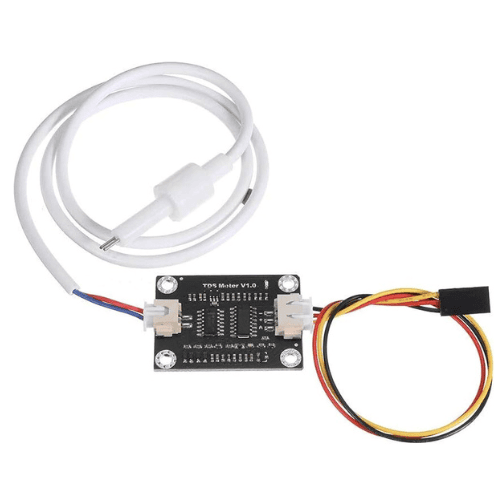
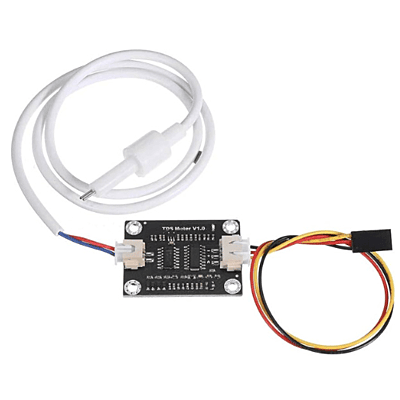

TDS Sensor Module for Arduino, ESP32 & Raspberry Pi | Total Dissolved Solids Water Quality Sensor
Monitor water quality with the TDS Sensor Module, compatible with Arduino, ESP32, Raspberry Pi, NodeMCU, STM32, and other microcontrollers. Designed to measure Total Dissolved Solids (TDS) in water, this sensor provides an analog output for easy integration into water quality monitoring systems. Ideal for aquariums, hydroponics, drinking water testing, aquaculture, environmental monitoring, IoT, and STEM education, it offers reliable performance for educational and prototyping applications.
Customize
Share :
Compatible with Arduino Uno, Nano, Mega, ESP32, Raspberry Pi (with ADC), ESP8266 NodeMCU, STM32, and other development platforms, the module provides an analog output that can be processed to estimate TDS values after proper calibration.
The sensor is widely used in water quality monitoring, hydroponics, aquaculture, aquariums, RO water systems, environmental monitoring, and IoT-based smart water management projects.
Note: TDS sensors estimate dissolved solids by measuring water conductivity. For accurate measurements, proper calibration and temperature compensation should be applied where required.
Key Features
- Measures Total Dissolved Solids (TDS)
- Water Quality Monitoring
- Analog Output Interface
- Easy Microcontroller Integration
- High Measurement Stability
- Low Power Consumption
- Suitable for Continuous Monitoring
- Compact Module Design
- Simple Calibration Process
- Ideal for Freshwater Applications
- Compatible with Arduino, ESP32, Raspberry Pi, NodeMCU, and STM32
- Perfect for IoT, Hydroponics, Aquaculture, and STEM Projects
Technical Specifications
| Specification | Details |
|---|---|
| Product Type | TDS Sensor Module |
| Measurement Parameter | Total Dissolved Solids (TDS) |
| Output | Analog |
| Operating Voltage | 3.3V – 5V DC |
| Measurement Unit | ppm (Parts Per Million) |
| Interface | Analog Signal |
| Calibration | Required for Accurate Measurements |
| Temperature Compensation | Recommended |
| Water Type | Freshwater Applications |
| Compatibility | Arduino, ESP32, Raspberry Pi (with ADC), NodeMCU, STM32 |
Applications
- Water Quality Monitoring
- Drinking Water Testing
- RO Water Systems
- Hydroponics
- Aquaponics
- Aquariums
- Fish Farming
- Environmental Monitoring
- Smart Agriculture
- IoT Water Monitoring
- Laboratory Projects
- STEM Education
- DIY Electronics
- Embedded Systems
- Engineering Projects
Package Includes
- 1 × TDS Sensor Module
- 1 × TDS Probe
Why Buy from Horizocart?
- Genuine quality-tested water quality sensors
- Reliable TDS measurement
- Fast shipping across India
- Secure packaging
- Competitive pricing
- Trusted electronics and IoT supplier
- Excellent customer support
- Ideal for students, researchers, makers, and engineers
Frequently Asked Questions
Q. Is this compatible with Arduino Uno?
Yes. It is fully compatible with Arduino Uno, Nano, Mega, Leonardo, and other Arduino-compatible boards.
Q. Can I use it with ESP32?
Yes. The TDS sensor works with ESP32 analog input pins for water quality monitoring.
Q. Does it work with Raspberry Pi?
Yes. It can be used with Raspberry Pi when an external Analog-to-Digital Converter (ADC) is used, as Raspberry Pi does not have built-in analog inputs.
Q. What does a TDS sensor measure?
It estimates the Total Dissolved Solids (TDS) present in water by measuring electrical conductivity and converting it to an approximate ppm value.
Q. Does the sensor require calibration?
Yes. Proper calibration using a standard TDS calibration solution is recommended for accurate readings.
Q. Can this sensor be used in seawater?
This module is generally intended for freshwater applications. Please verify suitability before using it in saltwater or high-salinity environments.
Q. What projects is this sensor suitable for?
It is ideal for hydroponics, aquaculture, smart irrigation, aquarium monitoring, water purification projects, and IoT-based water quality systems.